Learning Outcomes:
i. Define swallowing and explain its role in the digestive process.
ii. Describe the anatomy and physiology of the pharynx, esophagus, and sphincters involved in swallowing.
iii. Explain the process of peristalsis, the muscular contractions that propel food through the digestive tract.
iv. Discuss the role of smooth muscles and neuromuscular junctions in coordinating peristalsis.
v. Analyze the significance of swallowing and peristalsis in efficient food movement and digestion.
i. Swallowing: A Complex Sequence of Events
Swallowing is the involuntary movement of food from the mouth to the stomach. It is a remarkably complex process that involves a coordinated series of actions by various muscles and nerves.
Pharyngeal stage: The tongue pushes the food bolus (a ball of chewed food) into the pharynx, located at the back of the throat. The pharynx is a passageway shared by food and air.
Epiglottis closure: The epiglottis, a cartilage flap, folds down and covers the opening to the trachea, preventing food from entering the lungs and diverting it towards the esophagus.
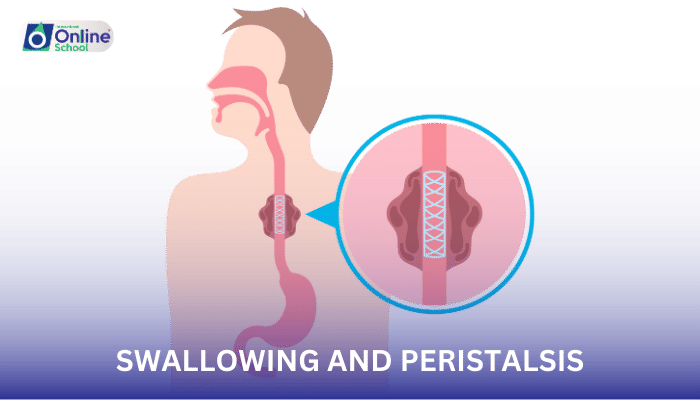
Esophageal stage: The esophagus is a muscular tube that connects the pharynx to the stomach. The smooth muscles of the esophagus contract in a wave-like motion, known as peristalsis, propelling the food bolus downwards.
Sphincter control: The esophageal sphincter, a ring of muscle at the junction of the esophagus and stomach, relaxes to allow the food bolus to enter the stomach.
ii. Peristalsis: The Driving Force of Digestion
Peristalsis is the rhythmic contraction and relaxation of smooth muscles that propel food, or any other material within a tube-like organ, through the digestive tract. It is a wave-like movement that originates behind the ingested material and travels towards the distal end of the organ.
Smooth muscles: The walls of the esophagus, stomach, and intestines are lined with smooth muscles, responsible for generating the peristaltic waves.
Neuromuscular junctions: Peristalsis is coordinated by a network of nerves and neuromuscular junctions, which transmit signals between nerves and smooth muscles, controlling the timing and strength of contractions.
The Significance of Swallowing and Peristalsis
Swallowing and peristalsis play crucial roles in efficient food movement and digestion:
Efficient food transport: Swallowing and peristalsis ensure that food is moved quickly and smoothly through the digestive tract, preventing blockages and allowing for proper digestion and absorption of nutrients.
Digestive enzyme activation: The movement of food stimulates the release of digestive enzymes from various organs, initiating the breakdown of food into smaller, absorbable molecules.
Protection from harmful substances: Peristalsis helps prevent the reflux of stomach contents back into the esophagus, protecting the delicate lining of the esophagus from damage.
Swallowing and peristalsis are essential processes that ensure the efficient movement of food through the digestive system. The coordinated actions of muscles and nerves generate peristaltic waves that propel food along the digestive tract, allowing for proper digestion, nutrient absorption, and waste elimination. Understanding these processes provides valuable insights into human physiology and the importance of a healthy digestive system.
